
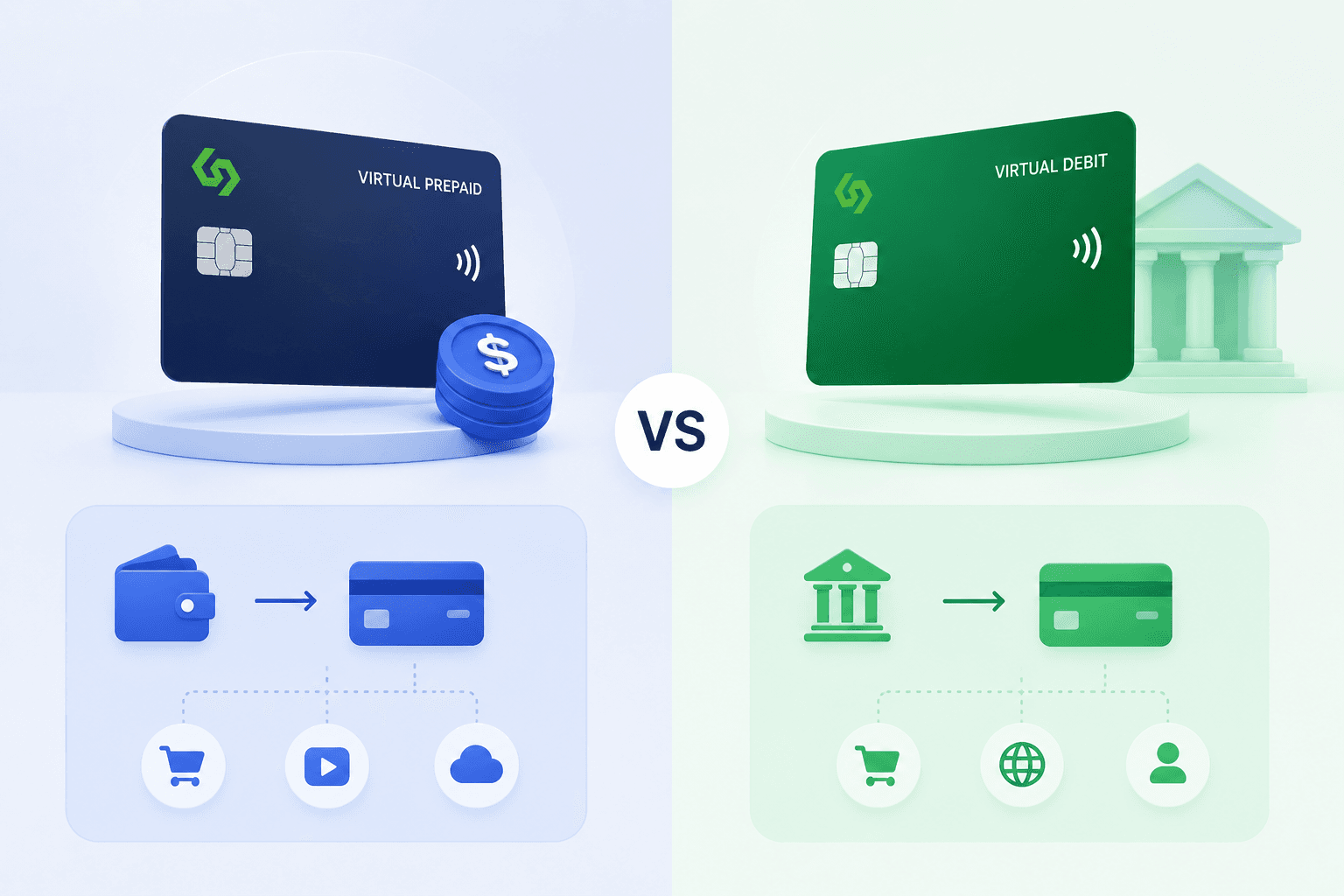
Virtual Prepaid Card vs Virtual Debit Card: Why SaaS Subscriptions Care About Credit Type
In U-card and virtual card use cases, the visible comparison is often between virtual prepaid cards and virtual debit cards. However, for AI tools, SaaS subscriptions, advertising accounts, and other recurring business payments, the more decisive factor is usually the card’s underlying classification within the Visa or Mastercard network: Prepaid Type, Debit Type, or Credit Type. Many U-cards available in the market are structured as Prepaid Type products, which are closer to stored-value cards. By contrast, higher-quality corporate card solutions are generally designed to provide merchants with a more stable and credible Credit Type payment signal.
If you are still evaluating the broader category of virtual cards, the first distinction to understand is simple: “virtual” describes the card format, meaning the card has no physical form. Prepaid, debit, and credit describe the funding and network attributes that merchants and risk systems evaluate more closely.
What is the core difference between virtual prepaid cards, virtual debit cards, and Credit Type cards?
A virtual prepaid card follows a load-before-spend model. Funds are placed on the card in advance, and each transaction is deducted from the available card balance. If the balance is insufficient, the transaction is typically declined during authorization. Because this model is not connected to a real credit line and does not require credit underwriting, it usually has a lower issuance threshold and a simpler risk-control structure.
A virtual debit card is generally connected to an account balance. When a payment is made, the funds are deducted from a linked bank account, payment account, or platform balance. It functions more like a standard account-based payment instrument than a pure prepaid card, but it is still not treated in the same way as a credit card by many merchants.
Credit Type cards are processed through credit card rails. From the perspective of merchants and card networks, they usually represent a more standard credit card payment route. Even when the user-facing U-card product still requires users to maintain a prefunded balance, a Credit Type underlying structure may present a materially different signal to merchant risk systems than a conventional prepaid card. In many higher-quality U-card models, users fund the platform balance, while the issuing and clearing path operates through Credit Type rails.
Type | Funding logic | Merchant-side perception | Best-fit scenarios |
Prepaid Type | Load first, spend later; insufficient balance is declined directly | More like a gift card or temporary stored-value card | One-off payments, fixed budgets, low-risk trials |
Debit Type | Deducts from a linked account or platform balance | More like an account payment tool | Everyday spending and ordinary online payments |
Credit Type | Runs through credit card network and issuing sponsor paths | Closer to a standard credit card payment signal | SaaS subscriptions, AI tools, ad spend, business expenses |
Why are SaaS platforms cautious with Prepaid Type cards?
Prepaid Type cards offer clear operational advantages. They are easy to issue, do not require credit approval, prevent spending once the balance is exhausted, and help users cap potential exposure. Yet for SaaS merchants, these same characteristics can also indicate higher payment risk.
SaaS businesses depend on predictable recurring billing. They prefer payment methods that are stable, renewable, and traceable over time. If a card cannot be charged when its balance runs out, or if the card can be easily abandoned after a short period of use, the merchant may face higher churn, failed renewal, collection, and support costs.
Prepaid Type cards are also easier to obtain and may appear more temporary to risk systems. As a result, they can be associated with a broader range of high-risk usage patterns. Large AI providers, cloud platforms, and SaaS companies often assign different risk weights to different payment methods. Even when prepaid cards are technically accepted, they may still trigger additional verification, transaction limits, regional checks, or account reviews.
Why can Prepaid's low threshold become a weakness in subscription payments?
For users, a low issuance threshold means faster card creation, stronger spending control, and a clearly limited balance. For merchants, the same feature can imply weaker payment credibility and a less predictable customer profile. The meaning of “low threshold” therefore changes depending on which side of the transaction is evaluating it.
For a one-time digital purchase, a merchant may only need to know whether the immediate payment succeeds. For an AI tool, cloud service, advertising account, or developer API subscription, the merchant must also assess whether future renewals are likely to succeed, whether the account can remain active over time, and whether the payment method is exposed to abuse.
For this reason, many SaaS platforms do not necessarily block prepaid cards outright. Instead, they may assign a higher risk weight to prepaid payments. A successful first payment only confirms that the initial transaction was approved; it does not guarantee that future renewals or account reviews will be treated in the same way. For subscription-specific card management, see our guide to paying SaaS subscriptions with virtual cards.
Why does Credit Type usually pass AI and SaaS subscription payments more easily?
Credit Type generally relies on a more complete issuing, sponsorship, and compliance framework, which may involve a bank, licensed EMI, sponsor bank, or another compliant issuing partner. Within the Visa or Mastercard network, its classification is closer to a standard credit card, which typically gives merchant risk systems a more trusted payment signal.
This does not mean Credit Type cards are never declined. Approval can still be affected by region, account behavior, billing address, IP address, device profile, merchant category, issuer policy, and other risk-control factors. However, under comparable conditions, Credit Type is often more acceptable to SaaS platforms, AI tools, and advertising platforms than Prepaid Type because it indicates a more stable payment profile and stronger customer-quality signal.
There is also an important operational distinction. If a user’s U-card balance is insufficient, the decline may originate from the U-card issuer or platform-level balance controls rather than from the SaaS merchant’s own risk system. This is different from a merchant directly identifying a prepaid card and applying a higher risk score at the merchant side.
Why does Infini use a "prepaid on the surface, Credit Type underneath" corporate card design?
Infini corporate cards are designed for cross-border teams, AI tool users, SaaS subscription teams, advertising teams, and digital business operators. In these scenarios, the primary requirement is not simply obtaining another card number. The real requirement is whether payments can be approved consistently, whether team spending can be controlled, and whether the funding model can support global operations.
The design principle behind Infini corporate cards is to preserve the user-side safety of top-ups and balance control while providing a higher-quality Credit Type payment route underneath. This structure is not intended to encourage overdrafts. Its purpose is to allow merchants to receive a more standard and trusted card-network signal, while Infini manages balances, limits, and risk controls at the platform level.
Based on actual usage feedback, Infini receives relatively few reports of corporate cards being declined for mainstream SaaS and AI tool subscriptions. For teams that need to maintain long-term subscriptions to OpenAI, Claude, Midjourney, cloud services, advertising accounts, or developer platforms, this underlying card-type difference can have a direct impact on daily operational continuity.
How should business teams understand payment approval rates?
Payment approval rate is not determined only by whether a card has sufficient balance. From a merchant’s perspective, a transaction is evaluated through multiple signals, including card type, issuing bank, BIN label, billing information, account behavior, region, device environment, and historical transaction patterns. Even if a Prepaid Type card succeeds on the first payment, it may still receive a higher risk weight during later reviews.
Business teams should evaluate payment approval rates across three layers. First, whether the card network and the merchant accept this category of card. Second, whether the issuer has stable sponsorship and compliance capabilities. Third, whether the platform provides practical business controls such as team limits, card freezing, transaction records, and reconciliation tools.
This is why low-cost card creation alone is rarely sufficient for business use. Teams that rely on AI tools, SaaS products, APIs, advertising platforms, and cross-border services need to consider the card’s underlying type, issuing quality, and platform capabilities in addition to issuance speed. To understand the full flow from authorization to deduction, read how virtual cards work.
When does Prepaid Type still make sense?
Prepaid Type remains useful in the right scenarios. It is suitable for one-off payments, gift cards, reward distribution, temporary budgets, low-risk testing, and cases where users do not want to expose a primary account balance. Its strengths are simplicity, control, and a clearly defined spending ceiling.
However, if the main requirement is long-term subscriptions, team collaboration, advertising spend, stable AI tool payments, or business-grade spend management, Prepaid Type may not be sufficient. Its balance limitations, temporary nature, and merchant-side risk label can all affect payment performance.
If you are comparing other card formats, you can also look at virtual credit card options. Credit cards, debit cards, and prepaid cards are not inherently better or worse than one another. They are designed to solve different problems around risk, cash flow, and merchant trust.
Which teams are Infini corporate cards best suited for?
Infini corporate cards are best suited for teams that require stable payments for global SaaS products, AI tools, advertising platforms, developer APIs, and cross-border digital services. Typical users include cross-border e-commerce teams, SaaS teams, heavy AI tool users, digital entertainment businesses, advertising teams, official-account transfer service providers, and operations teams that manage subscription payments at scale.
Compared with ordinary prepaid U-cards, Infini places greater emphasis on business-grade spend control. Teams can issue cards for different employees, projects, vendors, or subscriptions, set budgets and limits, and retain clear transaction records. For international teams holding stablecoin funds, Infini corporate cards can also connect naturally with stablecoin cards for international businesses, reducing friction associated with traditional cross-border funding routes.
If your team is affected by unstable AI or SaaS subscription payments, prepaid card declines, failed advertising account charges, or inefficient shared-card workflows, Infini corporate cards are better positioned as long-term payment infrastructure rather than temporary replacement cards.
How should you choose: Prepaid Type, Debit Type, or Credit Type?
If the goal is a one-time payment, a trial, or limited-risk spending, Prepaid Type is usually sufficient. If the need is ordinary account-linked spending, Debit Type can support basic online payments. If the use case involves AI tools, SaaS subscriptions, advertising platforms, or long-term business payments, a Credit Type corporate card with stronger issuing quality and better merchant acceptance should be prioritized.
Need | Better-fit type | Reason |
One-off payment or temporary budget | Prepaid Type | Balance is controlled and risk ceiling is clear |
Ordinary online spending | Debit Type | Account deduction is direct and convenient for everyday use |
AI tools and SaaS subscriptions | Credit Type | Merchant-side signal is more stable and risk weighting is usually friendlier |
Ad spend and business team expenses | Credit Type corporate card | Better suited for long-term payments, team limits, and reconciliation |
Ultimately, businesses should not only ask whether a card can be created. They should ask whether the card can support reliable business payments over the long term. That is the essential difference between Prepaid Type and Credit Type in SaaS subscription scenarios.
FAQ
Are most U-cards on the market Prepaid Type?
Many U-cards use Prepaid Type or a similar stored-value structure because issuance is easier, credit underwriting is not required, and balance control is straightforward. However, their merchant acceptance for SaaS and AI tool subscriptions may be weaker than corporate cards that operate with Credit Type underneath.
Why does Prepaid Type decline directly when the balance is insufficient?
Prepaid Type is based on a load-before-spend model. If there is no available balance on the card, the issuer usually will not advance funds for the user, so the transaction is declined at the authorization stage.
Does Credit Type mean users can overdraft?
Not necessarily. For corporate card products such as Infini, users must still comply with platform balance and limit rules. Credit Type primarily refers to the underlying card classification visible to merchants and card networks. It does not mean users are encouraged or permitted to overdraft.
Why do SaaS platforms prefer Credit Type?
SaaS platforms prioritize recurring billing, account quality, and payment stability. Credit Type usually carries stronger issuing sponsorship and a more standard card-network signal, so risk systems often treat it more favorably than temporary Prepaid Type cards.
Are Infini corporate cards suitable for individuals?
Infini currently focuses on businesses, global teams, and business payment scenarios, especially SaaS subscriptions, AI tools, advertising spend, API costs, and cross-border operating expenses.
If I only pay occasionally, do I still need a Credit Type corporate card?
Not necessarily. Occasional one-off payments can be handled with Prepaid Type. However, if you need long-term subscriptions, stable billing, multi-account management, and team spend control, a Credit Type corporate card is generally the more suitable option.


